This story is inspired by the works of C.S. Lewis, particularly The Great Divorce, which I had just read when the idea for this story came to me. The question that sparked the idea was this: “What would it be like if we really knew what people think of us?” This is not a pure allegory, but some aspects of it are. I hope you enjoy it, and I hope it makes you think. Stay tuned for Part 4! If you’d like to know whenever I publish a new blog post, feel free to subscribe to my email list.
The Mending
I stood with my back against a tree, shuddering. I could not escape the memory of what I had seen; every time I closed my eyes, that woman was before me again, writhing in the tower room.
“What—what happened?” I said to Lewis, who sat on a stump nearby, twiddling a bit of grass between his fingers.
He had led me to an enclosed park on the other side of town, far from the prying ears of the people in line, for the wall around the park had only one entrance, and the line could not pass through.
“It was the Mirror,” he said, not looking up.
“But how—what did it do to that poor woman?”
“That poor woman still had a choice, you know. She chose to sign the paper.”
I opened my eyes and sat on the grass next to him. “Why?”
He sighed and rubbed his eyes. “The people in line are all waiting to see something terribly exciting, something they know everyone else wants to see, and therefore something of great value. When they reach the door, they are so frantic and so tired that they sign without hesitation, without bothering to examine the contract first.”
“What contract?”
“It states that they agree to serve the Taskmaster for seven years in exchange for beholding the Great Wonder. Once it has been signed, they are in bondage. But that’s only the beginning of their misery.” His voice sounded hollow and strained, and I remembered what he said before.
“Is that what you did?”
Lewis nodded, and a moment or two passed before he spoke again.
“The wonder of the mirror is that in it you see yourself exactly as others see you. It is something they—we—want, but not something we really need. For when we behold ourselves in the mirror, when we see ourselves with all the admiration and love and enjoyment, or envy and hatred and lust, of those around us, we become one of two things: miserably proud, or miserably ashamed. And either result transforms the viewer into something hideous. For what you behold is what you become.”
His words sank into my heart like a stone, and I could not speak.
“They lead the victims of the mirror underground, beneath the Tower, to work the ancient mines and serve the Taskmaster for the allotted seven years. However, most of the prisoners are so disgusted with themselves, so appalled at what they’ve become, that they choose to stay. There are thousands and thousands below us, even now.”
I blinked at him. “How did you escape? How do you look—”
I didn’t finish: he knew what I meant to say. He looked nothing like the mutilated face of the woman I had seen. He looked as if nothing had happened to him at all.
“Every year, the prisoners are permitted one excursion into the light. We were herded through a tunnel on the west edge of town, and brought to a dock on the river. A smiling man was there, with a great white ship tied to the moorings. He told us he offered each one of us a chance to buy our freedom from the mines, to escape the hand of the Taskmaster and the chains we wore. But it came at a price: we would have to sail away with him to a different land, and we were not promised a return. He told us we could be rid of our horrid appearances, but we must leave behind the only life we’d ever known. Most of my companions said no, every year. I said no the first three. But the fourth year I had grown unbearably depressed and weary of the Taskmaster, and I decided to go with the smiling man, if only to throw myself off the ship and be rid of my misery in this life forever. Only a few hours into our voyage, I decided it was time. I leaned over the railing, looking at the dark, churning waves below. I felt that I deserved no better end than to sink beneath them.
“But a gentle hand stayed my arm. ‘Whatever dark thoughts are assailing you now, my friend, I bid you let them rest.’
I could not look him in the eye; I knew I would repulse him.
‘Sir, my life is not worth living; it would be better for me to lie at the bottom of the sea, where no one would ever have to lay eyes on me again.’
‘Don’t speak like that.’
And then he did something I did not expect. He lifted my chin and turned my face toward him. His eyes looked directly into my misshapen ones, and he did not flinch.
‘You have chosen to see something that should be forbidden to men, and it has maimed you. You do not look like yourself anymore; you have allowed what you beheld in the mirror to turn you into something atrocious. But that is not an irredeemable mistake.’
‘It isn’t?’ said I, hardly allowing myself a glimmer of hope, for fear that I would be gravely disappointed.
‘Of course not. The power of the Taskmaster runs deep through the earth, but there is a greater power, one which can change you back into exactly who you should be.’
‘What must I do?’
He smiled. ‘You must behold it.’ He nodded toward the prow of the ship, which pointed upstream. ‘We must travel away from here, to my home country. There you will be given rest and refreshment, and the process of your restoration will begin.’
I said nothing more. I was grateful for his kindness, but terribly frightened.
What must I endure to become myself again? Would I ever return home?”
Lewis paused. A quiet wind blew over us, tousling his sandy hair. He breathed deeply, drinking in the sweet fragrance of the flowers in the park. Then he continued:
“We journeyed for ten days and nights, through calm and storm, and always upstream. At last the river widened, and we came to a great waterfall.
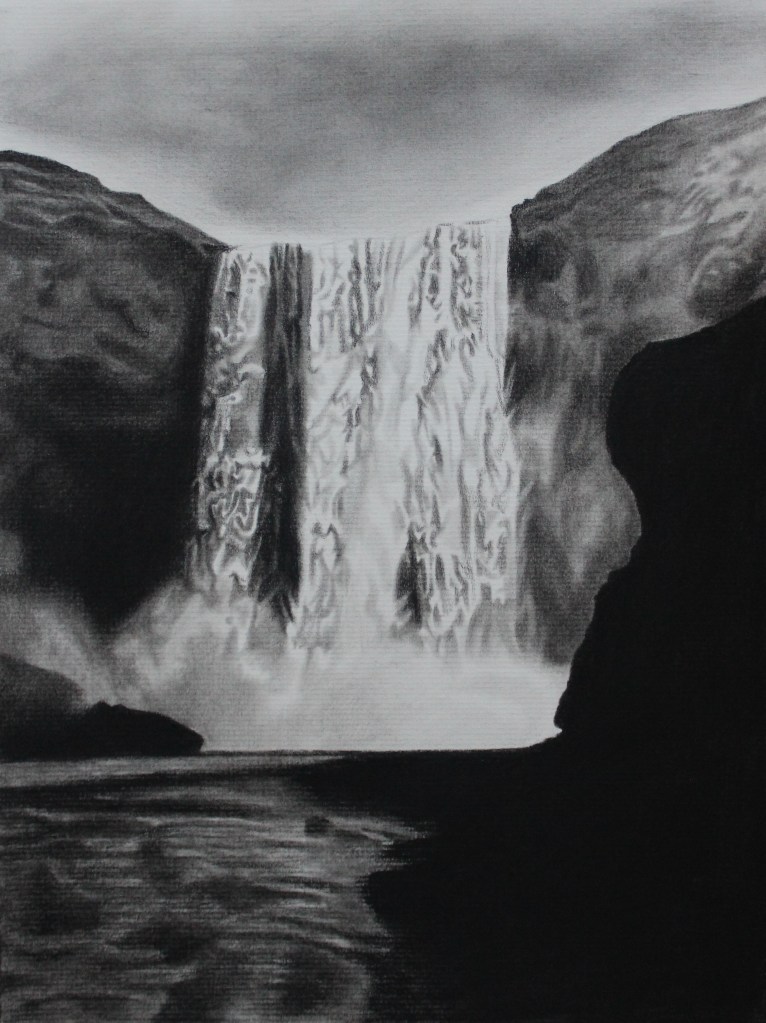
“Here my benefactor moored the ship and bid me follow him ashore. I was given food, clothing, and a comfortable bed in a room with other former slaves, who all seemed happy and content. Thus began my restoration. Every day I walked in the garden near the waterfall, feeling the fresh spray on my skin, and every day my hope revived, and I felt a little more like myself. We were given work to do, but it was good work, the kind that makes a man feel healthy. We had no mirrors, not even a bit of glass to catch our reflections in. After a few months of this, I was enjoying myself immensely, but still I looked disfigured; my appearance had not improved in the least. I went to the benefactor:
‘Sir,’ I said, ‘I don’t mean to sound impatient, but when will I begin to look like myself? I can feel the roughness of my skin; I can feel all the bumps on my sagging face. When will I be changed?’
The benefactor smiled at me. ‘It is not wrong, the desire to be whole. Actually, I was only waiting for you to ask. I think you’re quite ready.’
He rose, beckoning me to follow him. We climbed a narrow ledge along the rocks until we reached a secret little cave behind the waterfall, hidden completely by the falls and the great rushing noise of their descent. The cave was empty, save for a stone pedestal in the center, cut out of the rock. Something lay atop it, and as I watched, a bright kaleidoscope of color beamed from its surface, dancing across the walls of the cave.
‘Prisms of sunlight refract through the water and are reflected from the mirror; that’s what makes these colors,’ explained the benefactor.
‘A—a mirror?’ I said, choking on the words.
‘Yes. But do not fear. It’s quite different from the one in the tower. It will turn you back to what you should be; I promise.’
I looked at him. I had no reason to doubt his words. In everything he had proven to be a faithful and true friend.
‘Go on,’ he said, holding out his hand toward the mirror. ‘I’ll be right here.’
Slowly I approached the pedestal. The colored light danced upon my face. I reached out and took hold of the mirror.”
“And what happened?” I said with bated breath.
Lewis looked dazed, lost in his reverie.
“At first, I couldn’t see anything. The mirror was blurry. I wondered if something had gone wrong, if I had gone wrong, beyond any hope of healing. Then I saw a face—still dimly, as if through a fog, but I could tell it was not my own. Even through the mist, though, it was the most beautiful face I had ever seen, full of wonder and mystery, terror and majesty—yet beaming, warm with kindness and love. The picture was ever-shifting, and I tried so hard to make it come into focus, but try as I might it would not. Still I could not tear my eyes away for quite some time.
“At last, the benefactor took the mirror gently away from me and held my face in his hands, brushing my tears away. I had not realized I was crying.
‘Look at yourself’ —and he produced a small mirror from his pocket. ‘You’re exactly as you should be.’
Amazed, I beheld my own reflection in the mirror, looking just as I do now. I touched my smooth skin; I felt the thick, clean strands of my hair; I stretched my straight, tall back. I was myself again—and yet I was different.
‘Who was that, benefactor?’ I said.
With a smile, and tears in his own eyes, he said, ‘That was the Inventor, the one who made the mirrors.’
‘Mirrors? You mean he made the other one, too?’
The benefactor nodded.
‘Then how could it do such terrible things? Has he really such malice in his heart? I would not think so, from looking at him.’
‘Of course he doesn’t. Both the mirrors were good at first, you know. Neither one could do any harm. One was made for the viewer to delight in the love of the Inventor, and the other to delight in the love of his friends.’
‘So what happened?’
‘The Taskmaster got his hands on it. With his power, he turned it into something evil, something that could twist and bend your hearts to crave what they were not intended to live on. In this way, he could manipulate you into doing his work.’
‘Then how did I return to—to myself, just by looking at the Inventor?’ I said.
‘Well, you certainly couldn’t change just looking at yourself,’ laughed the benefactor. ‘All goodness and beauty come from him. That’s why, if you want to become anything good or beautiful, you must look at him.’
‘Will the picture ever become less blurry?’
‘A little, perhaps. But it will never be perfectly clear, not in this life. You couldn’t bear it.’
I embraced the benefactor. ‘Thank you.’
‘You’re more than welcome, my friend. You were never hideous to me—I could see you as you are now from the beginning.’
‘What must I do? Shall I stay here?’
‘No, no. This is a temporary dwelling for most, a place of healing and restoration. Now that you have been transformed, you have been given a special assignment: you must return to your homeland and warn others not to look in the mirror at the tower.”
And he sent me, and here I am.”

 Jenna Leigh Design Co.
Leave a comment