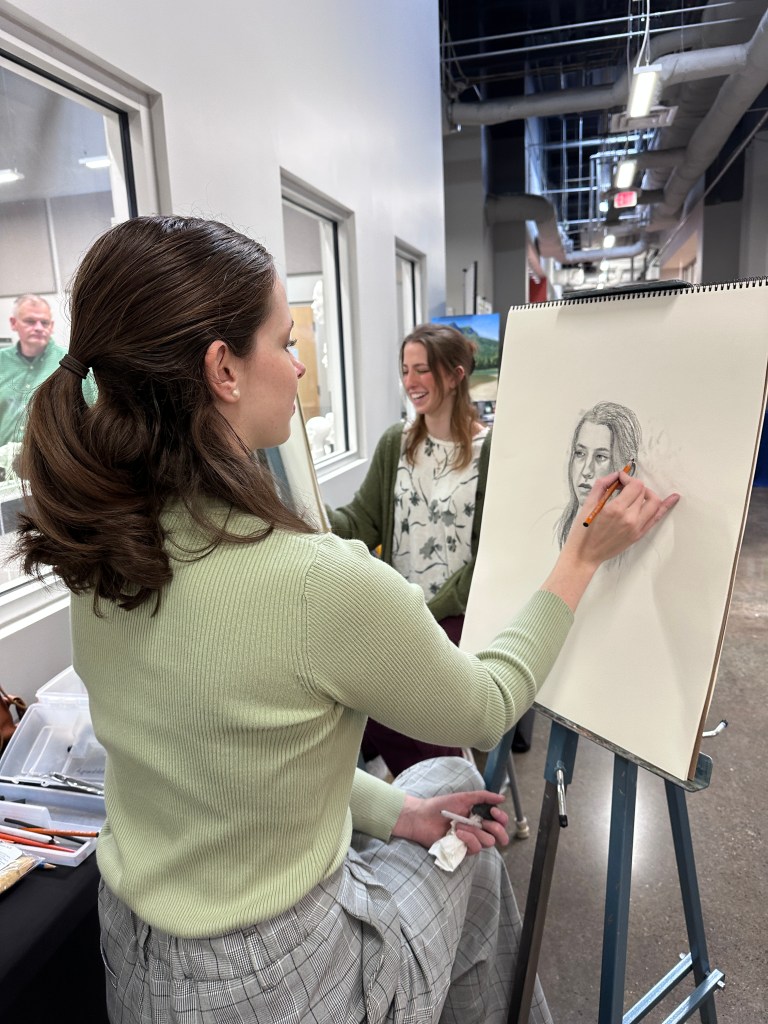
It’s pretty risky drawing a portrait of someone you know well. The stakes seem higher, because if you do badly, or if you mistakenly emphasize some aspect of their features they’re not particularly fond of, the portrait may cause a breach between you that cannot be easily mended.
Let’s hope that’s not the case this week.
So far, the subjects of my last two portraits (Elise and Mary) were also friends of mine. The portraits were not a perfect likeness by any means, but they did capture some elements of each subject’s persona, and my friends were not offended by any dissimilarities.
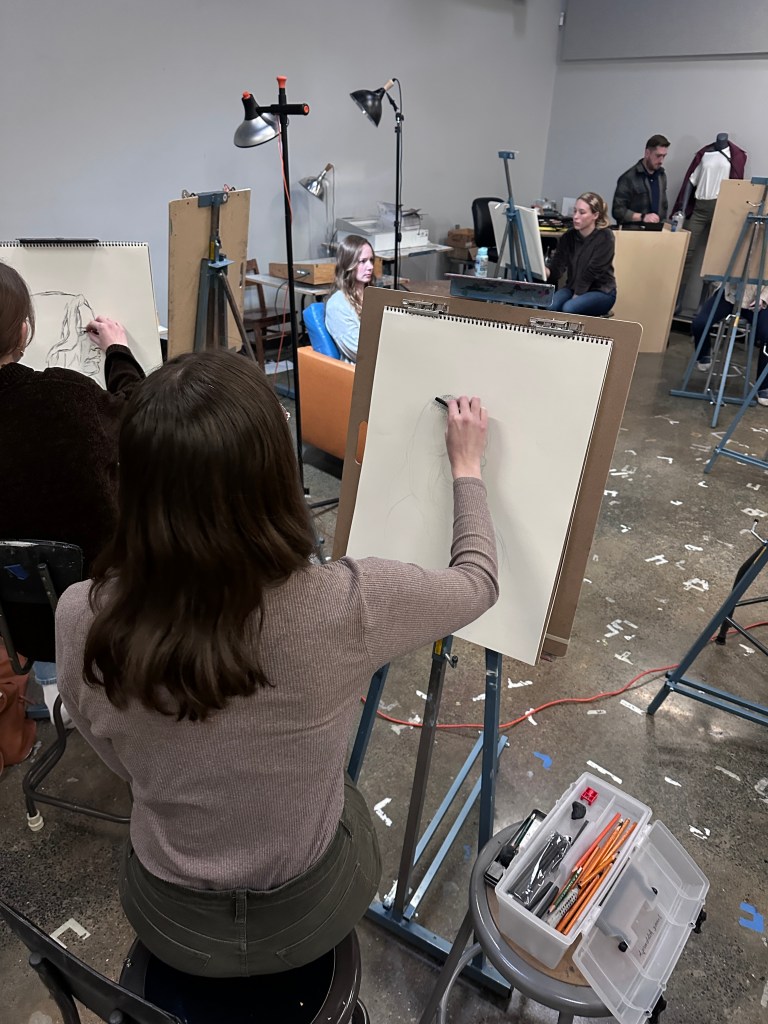
This week, another friend from class and I bravely added a new challenge to our life drawing adventure: we attempted to draw each other, while drawing each other.
Easy, right?
Other than trying valiantly not to laugh at times, or change our expressions in any way, or alter our posture, overall our endeavors went well.
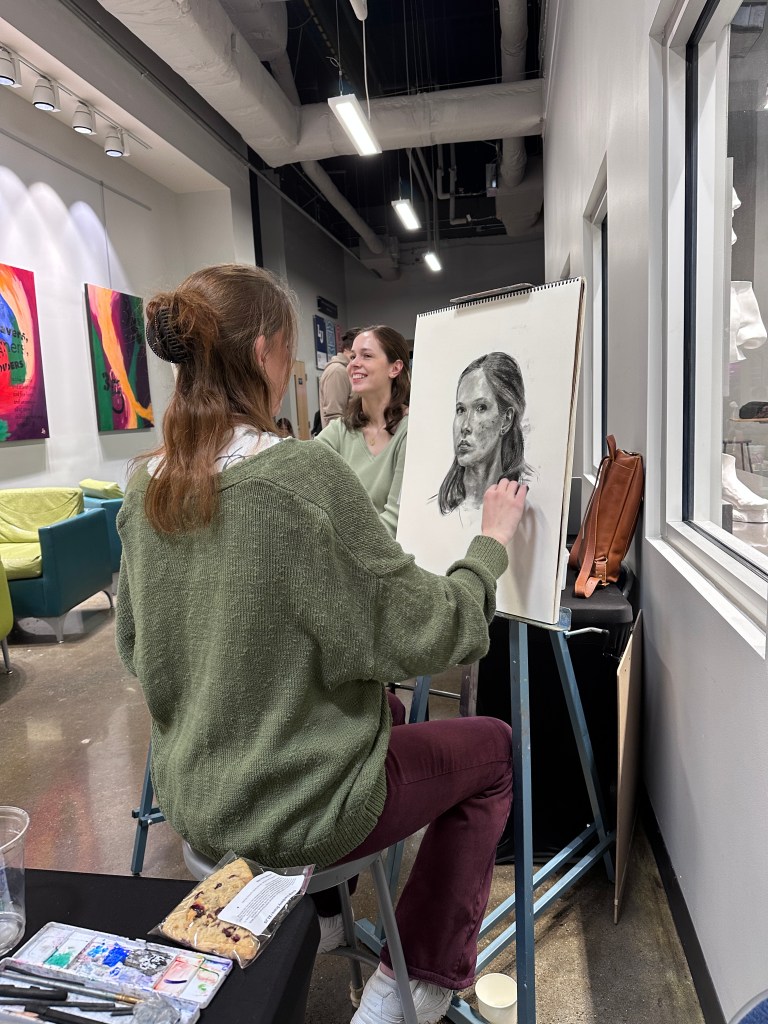
Drawing Natalie drawing seemed fitting, since art is an important part of who she is and something she loves to do. I got the chance to capture her look of intense concentration as she rendered my own, and during breaks between sessions we got up to examine each other’s work.
Let me walk you through a quick review of my process:
Drawing Process
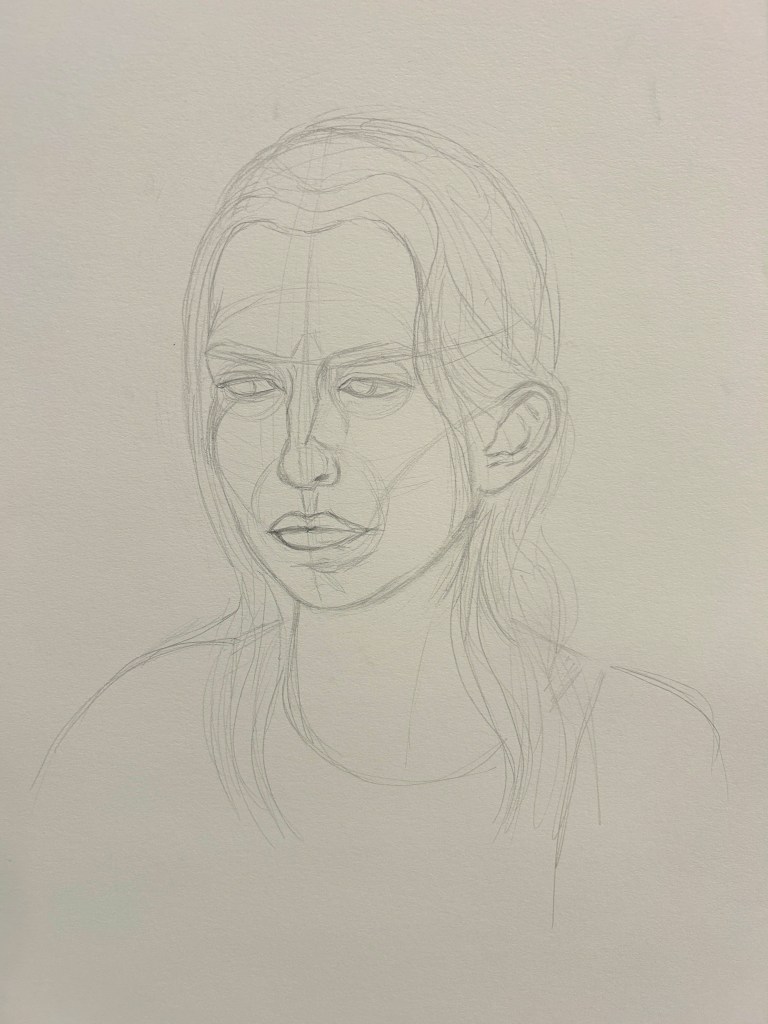
As always, drawing began with a line block-in of basic proportions and a quick indication of primary shadows. This went decently well, especially considering how difficult it was for either of us to maintain a perfectly still position while drawing.
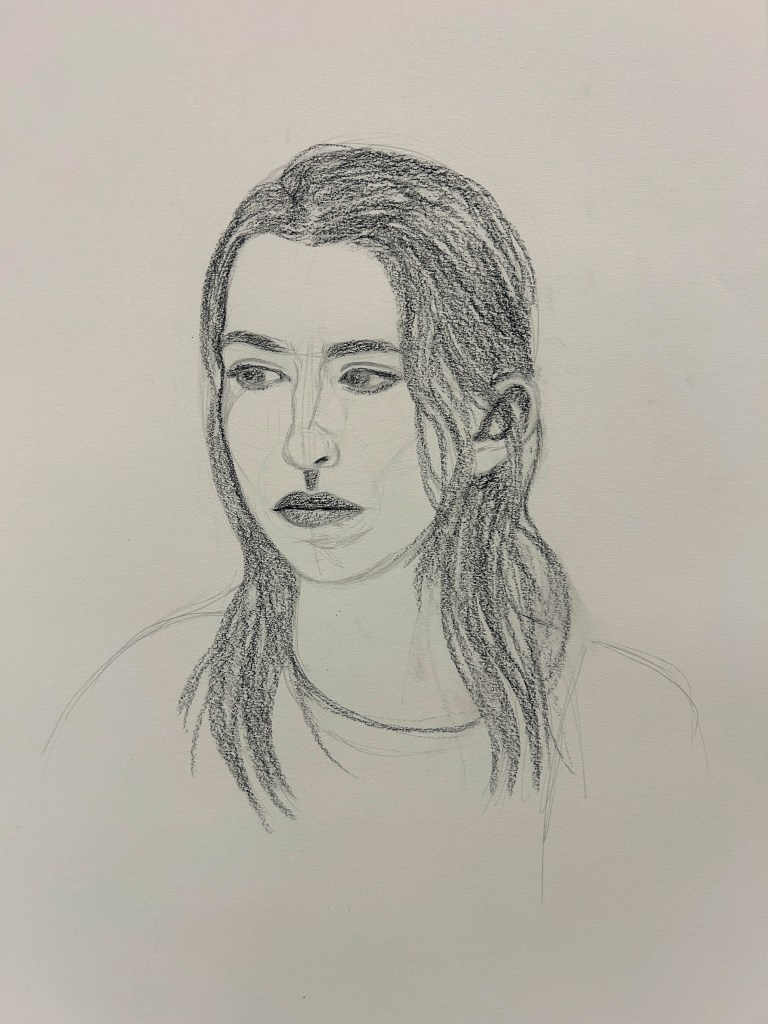
Next, of course, I mapped out the darkest values in my drawing, including hair and facial features. Sweeping the charcoal with the side of my hand allowed me to easily tone the lighter values of the face.
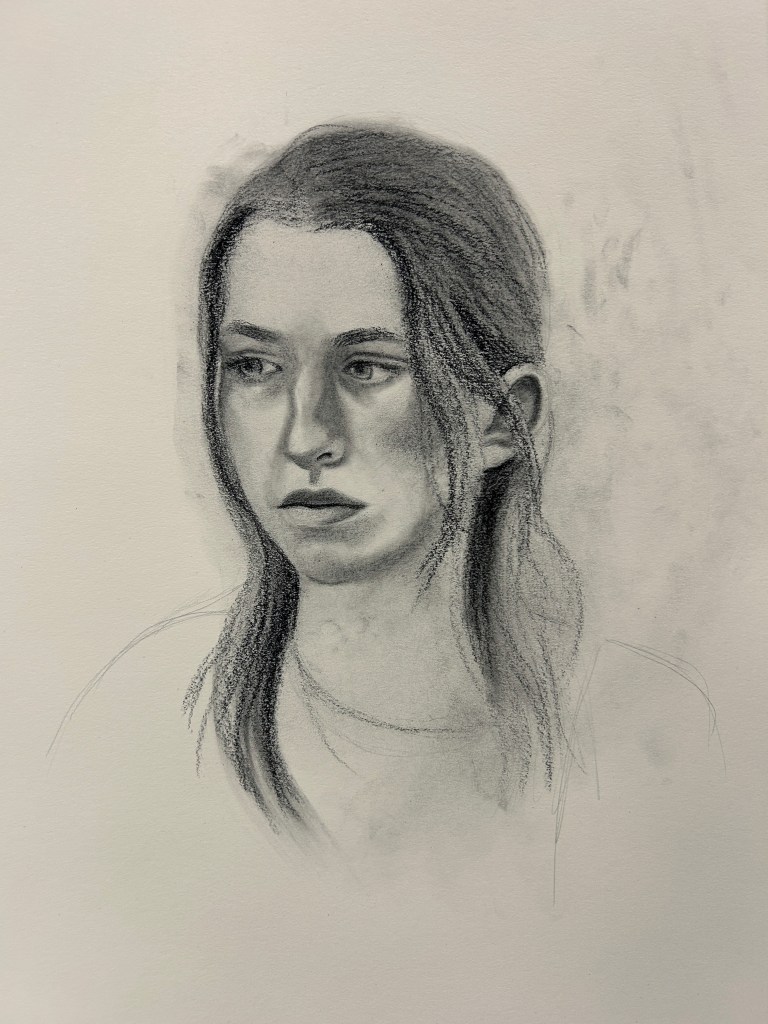
Further rendering established midtone values and began defining the facial features. By this point, I knew I had a Natalie-ishness to my portrait, but I still had a lot of work to do. Checking my measurements revealed that something about her eye placement/size was off, and I had to adjust these proportions several times.
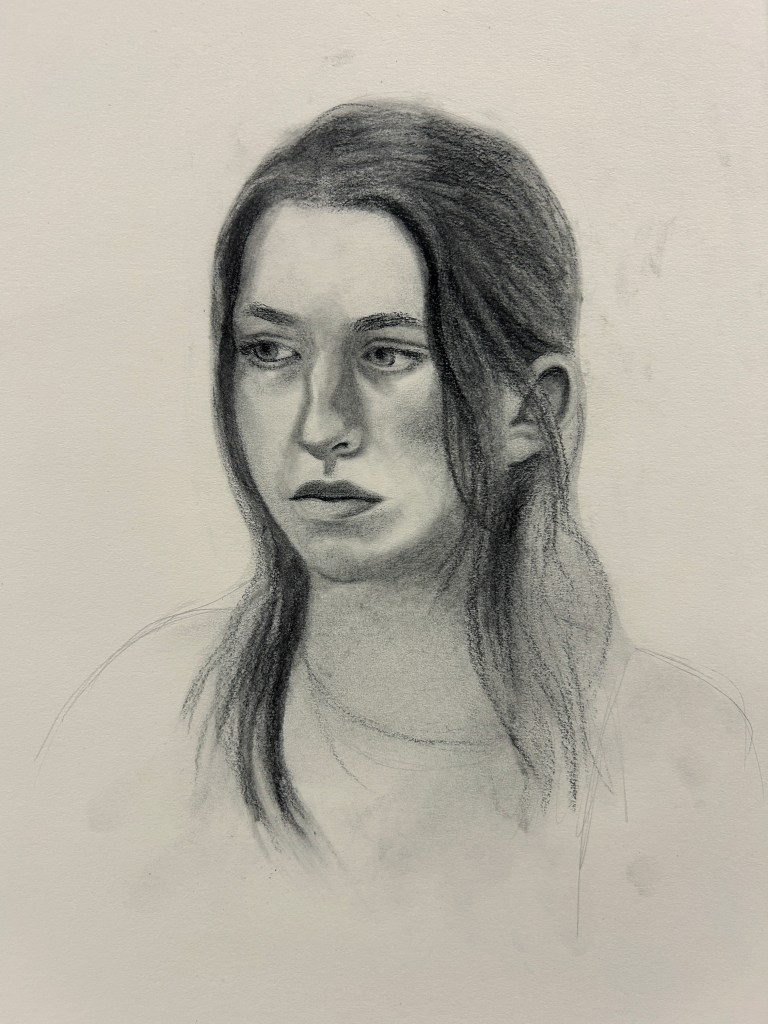
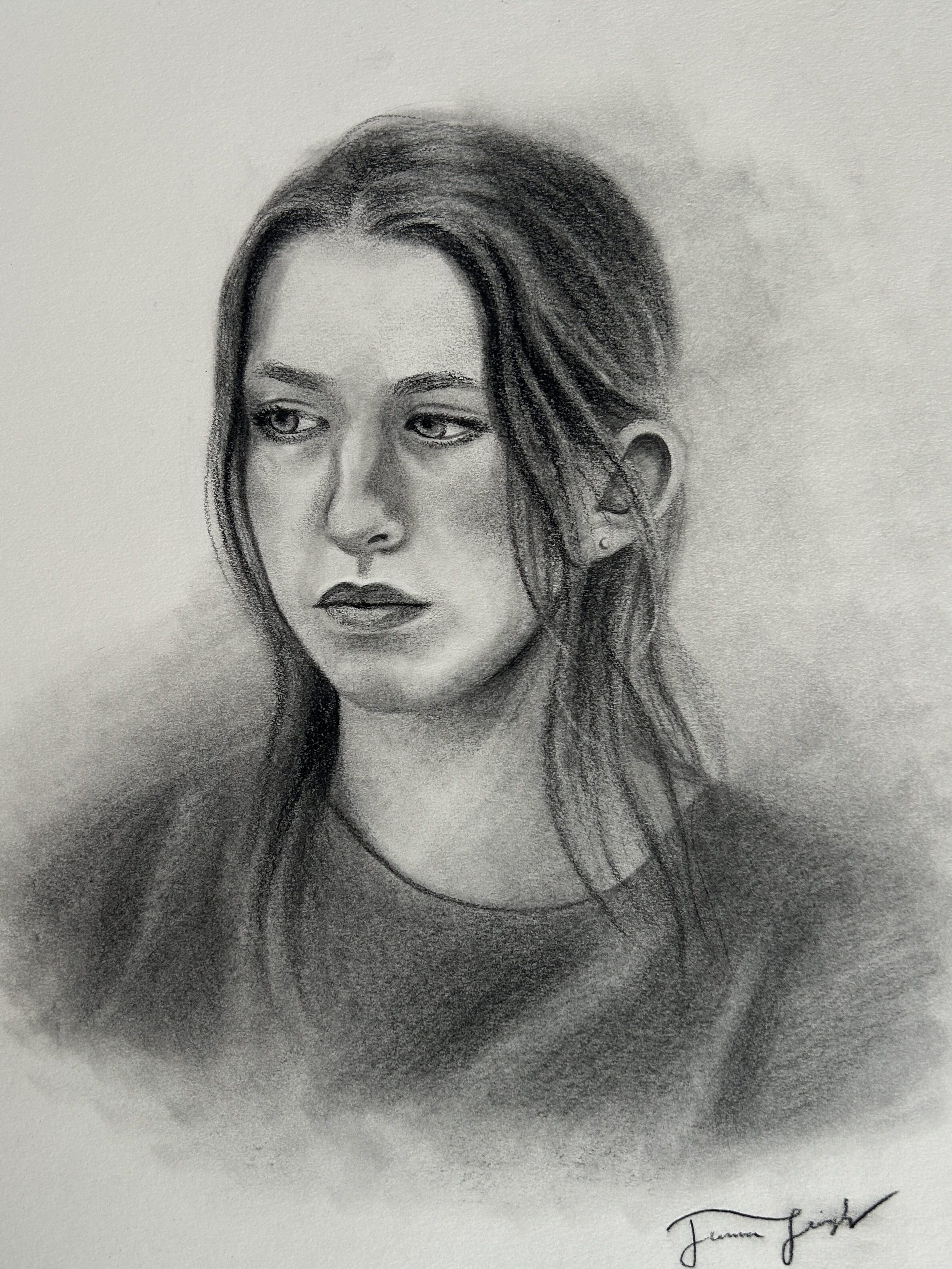
Here’s the final portrait:
Reflection
What went well for me this time:
- My other portraits have been pretty big, at least life-size. This time I was able to render my subject at more of a hand-size ratio, and I found it helped me to simplify my interpretation of what I was seeing, rather than trying to create/add details that weren’t there.
- I wasn’t sure how our setup would work, but it ended up working just as well for us as drawing a *still* model sitting in a chair, as we usually do.
- Every time I practice drawing from life, I know I am improving at finding correct proportions, using different charcoal techniques, and rendering likeness.
- It was fun to render eyes looking up; my other two portrait subjects were looking down (which either makes them look bored, mad, or sleepy in my drawing).
What challenged me the most:
- No matter how many times I check, I ALWAYS end up finding a proportion error soon after establishing darker values! It usually has something to do with the eyes, which I am just realizing now as I type…this is a helpful revelation, I suppose.
- My values are so soft, light, and blended, no matter how much I try to push that value contrast. I think I have a pretty good balance of lights and darks, and then I look at someone else’s portrait, and mine is a ghost in comparison!
- Charcoal texture is…difficult. Especially for a detail-oriented perfectionist.
So much room to improve and grow. But I have to remind myself that growth is happening, whether I can see it clearly or not. Every time I sit down with my charcoal sticks and huge drawing pad, I am making a commitment to my craft, dedicating my time and energy to getting even just a little tiny bit better.
Again, there is a Natalie-ishness in my portrait. It’s not a perfect representation, but when I look at it, I see her. It is Natalie-esque, if you will.
And that’s kind of the wonderful thing about drawing portraits…
We are all made in the image of God, and I think we all reflect Him differently. Not only that, but I think we see His image uniquely in one another. It’s one of the reasons we need each other—to know the image of God in a whole kaleidoscope of colorful perspectives.
So, when everyone in my Life Drawing class sits down in front of a model, puts pencil to paper, and starts drawing—
The results can look almost nothing alike!
We all perceive things in our own way. You can call it style, or preference, or technique, but at the heart of it I think it’s the image of God being manifested through the precious human beings He has made.
So what is the difference between likeness and interpretation?
Of course, we want our portraits to accurately resemble our subjects. We are working toward realism, after all.
But the interpretation is what makes us artists.
Not only that, it’s what makes us image-bearers.
And what an honor it is.
Charcoal Portraits Summary
Alas, that brings us to the end of our charcoal portrait module in Life Drawing (except you will see one more from me, because I missed the first week!) I enjoyed the experience, despite the challenges and frustrations, and it brought me back to my time taking the same class in undergrad.
If I could share anything I’ve learned over the past few weeks with someone embarking on a similar study, I think I would tell them that:
- They should buy Nathan Fowke’s seminal charcoal portrait book, How to Draw Portraits in Charcoal. It will help immensely, especially if you do not normally work in charcoal.
- They should be bold with their tools and not afraid to make strong, expressive marks! (I am speaking to the choir…i.e. myself)
- They should take advantage of the natural properties of charcoal, rather than trying to make it conform to a tighter, more precise medium.
- They should invest in/experiment with a variety of tools to discover which ones work best for them.
- They should seek/implement feedback from someone experienced and knowledgeable in this kind of work.
It’s been fun to work alongside my friends. It’s been fun to revisit this humbling, addicting, rewarding practice. Even in just a few weeks, it has sharpened my skills as an artist, reminding me that there is always, ALWAYS more to learn, and I’m just getting started.
 Jenna Leigh Design Co.
Leave a comment