We have had particularly unpredictable weather here in Lynchburg this April. Last week we had our “last frost.” We were wearing sweaters.
This week, temps reached 90.
Just in time for our plein air painting to get into full swing!
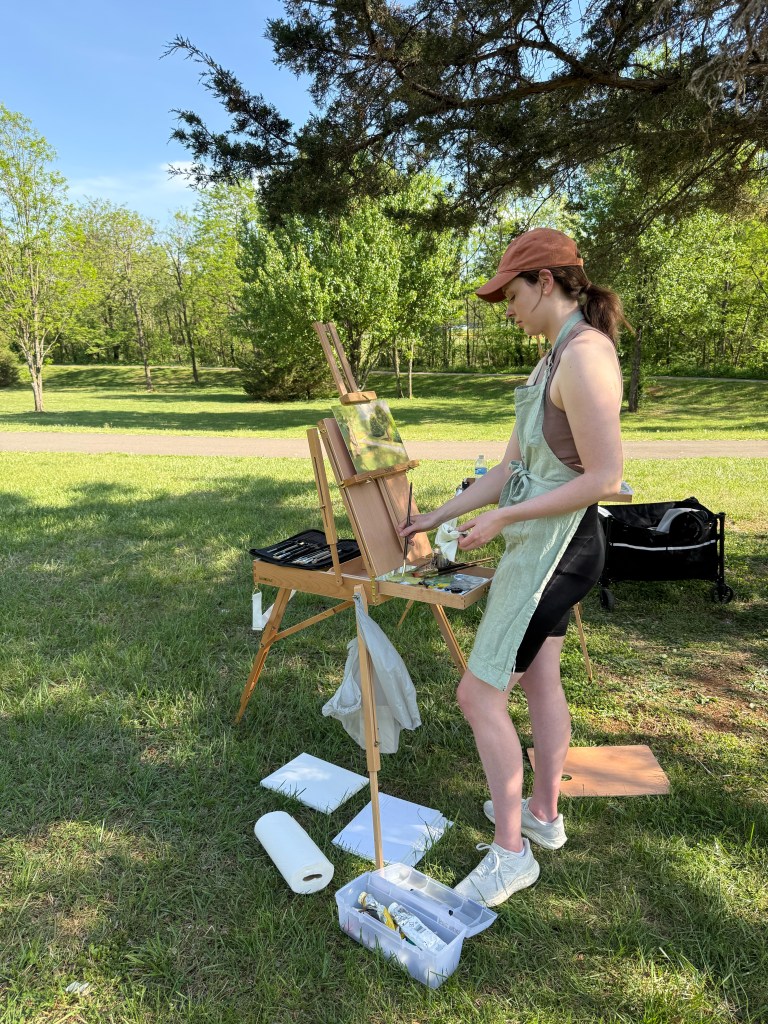
Thankfully, I’ve been out for three sessions so far, and each time I have been able to set up under the shade of a tree. (I always bring sunblock nonetheless.) Yesterday, despite the withering heat, I barely even broke a sweat during our nearly four hours of painting, set up, and clean up. A pleasant breeze was blowing, and the bugs (mostly) minded their own business.
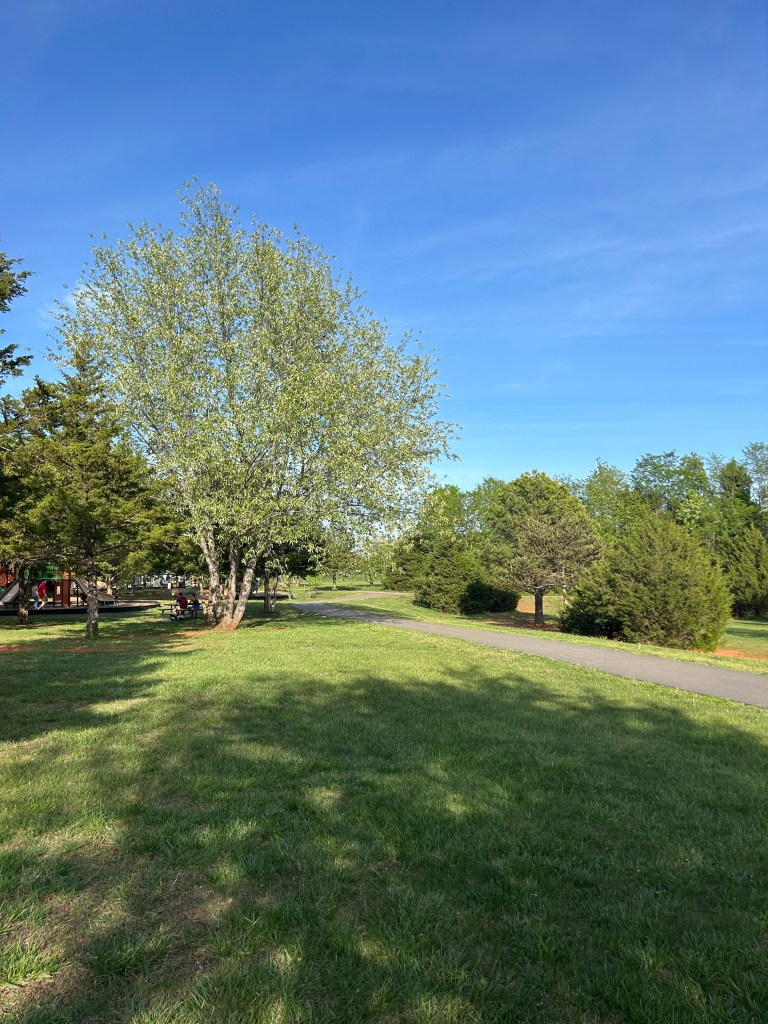
My friend and I decided to paint at the small park adjoining Forest Library, which includes a playground and a short path encircling clumps of trees. The path provided a nice center of interest, and the variety of trees would give us a fun challenge.
*CONFESSION* If you read my last post (Plein Air Painting: Getting Started), you will know that my first plein air painting session went relatively well.
Our class set out together Saturday of that same week for some collective plein air.
I felt ready. I knew what to do. I knew how to set up my French easel. I had a whole three hours already under my belt. What could go wrong?
TREES!
Trees were the bane of my second session. Trees, and setting up too close to the scene. There was no center of interest, no depth, no pleasing shape or texture. My painting lacked variety and value contrast.
I was so dissatisfied with my work by the end of the day that I wiped it ALL off the canvas, loath to waste my art supplies on such an incriminatingly abhorrent painting.
(I know, that’s a bit dramatic.)
Needless to say, I was a bit nervous for this third session. We had chosen a landscape that included multiple kinds of trees: near, far, short, tall, sparse, full. There was no way around them, and no way to escape the necessity of attempting to paint them well.
I may have prayed a few times beforehand.
Let me show you how it went:
Painting Process
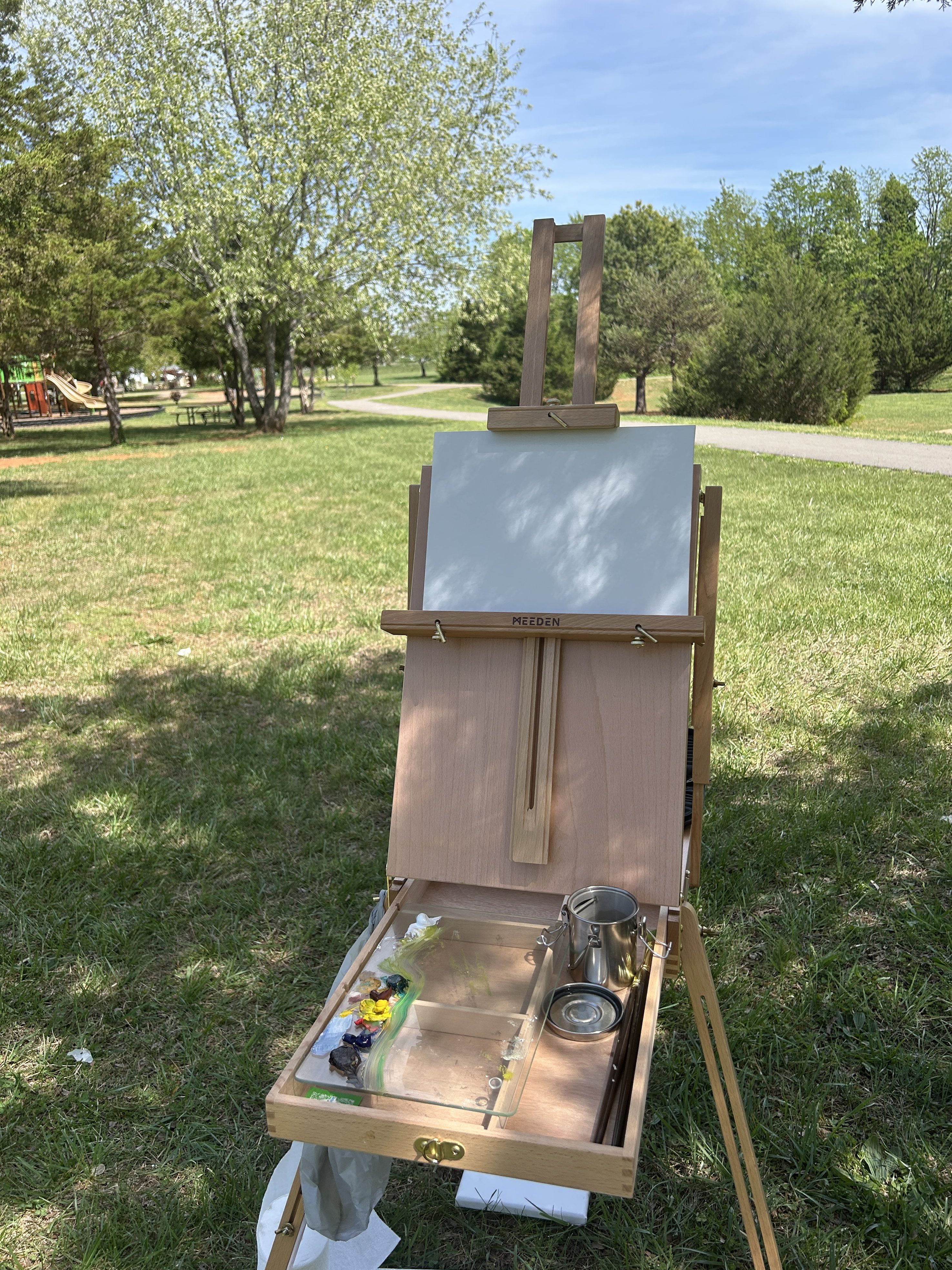
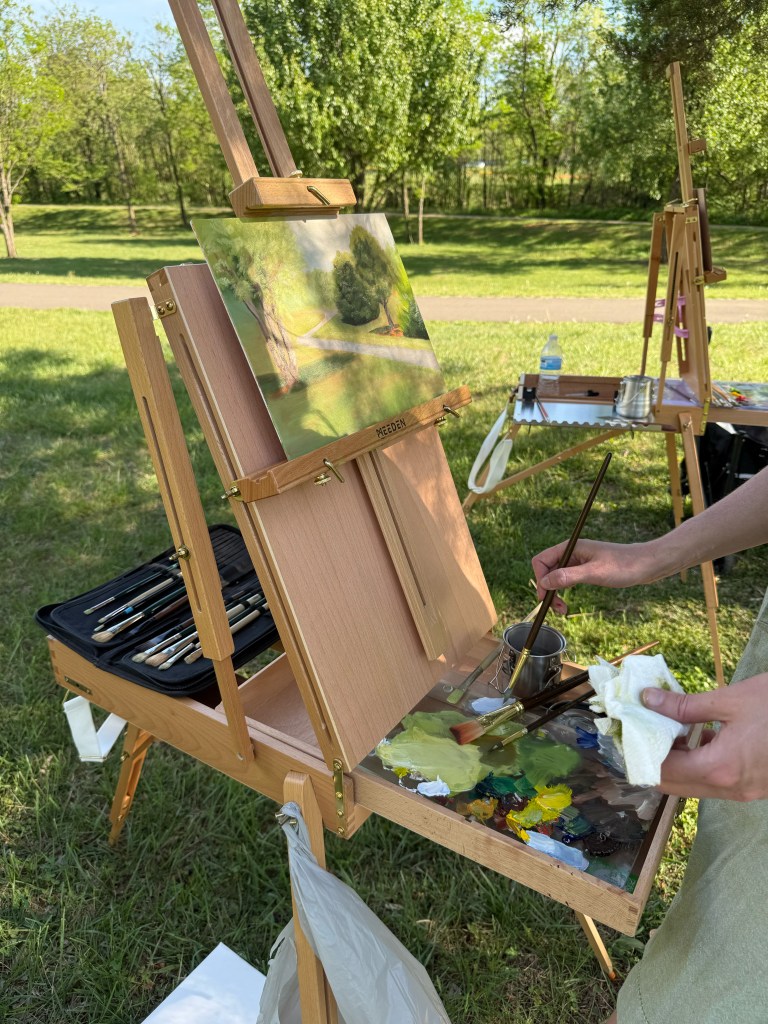
Here’s my setup before I got started.
The goal this week was to focus on using a limited value structure and color palette, so I kept that in mind as I worked, beginning with a simple underpainting that established my composition and basic values:
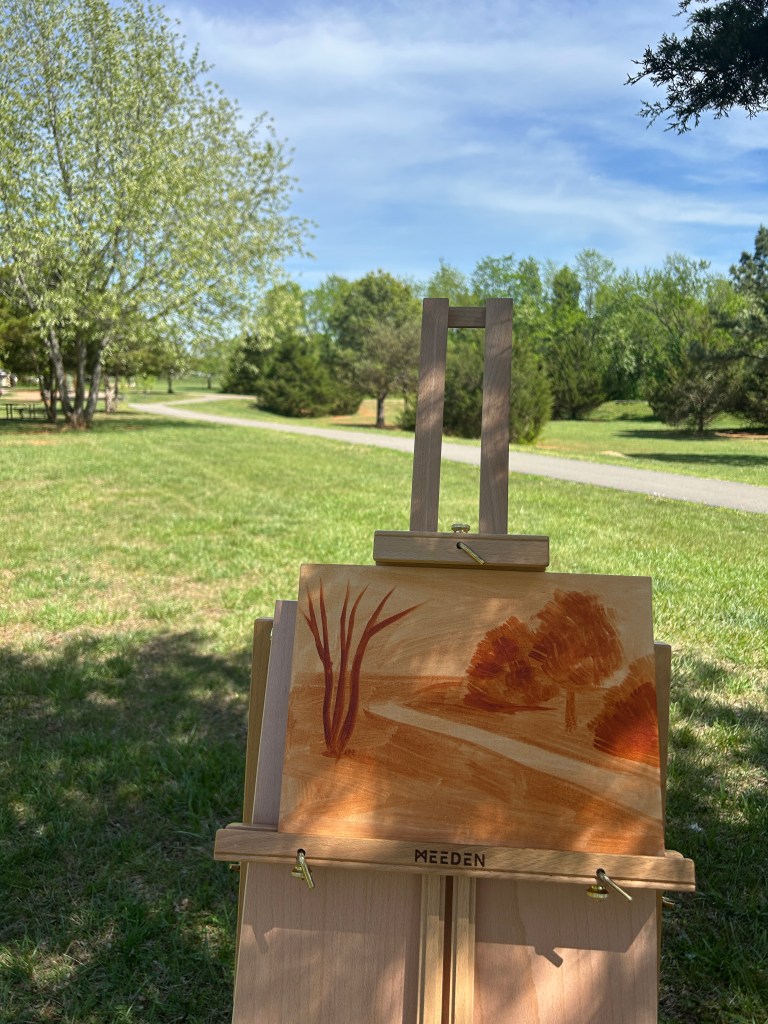
I then moved on to blocking in major masses of color. Unlike my previous attempts, this time I consciously left places where the underpainting showed through, popping hints of warmth into the otherwise unbroken sea of green.
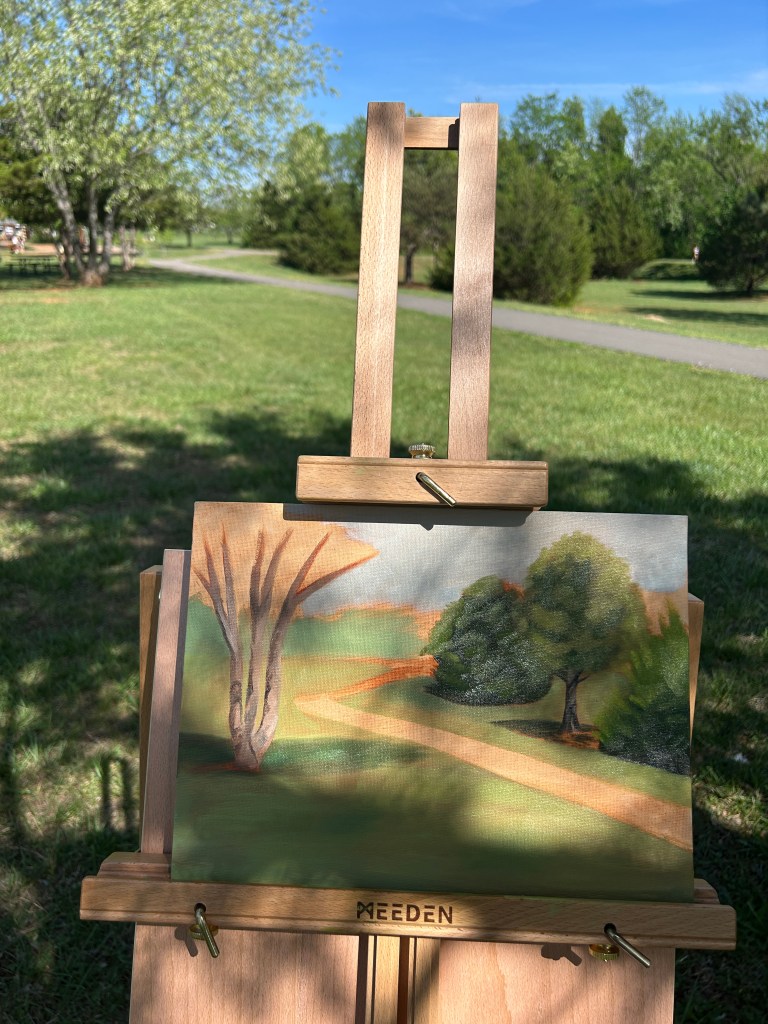
You may notice here one of the main challenges I faced during this session:
Dappled light. As the sun moved west across the sky, the shadow from the tree overhead moved, casting patterns on my canvas. This made it quite difficult to accurately judge some of my colors and values, and I frequently had to move to the side to observe my painting from a different perspective.
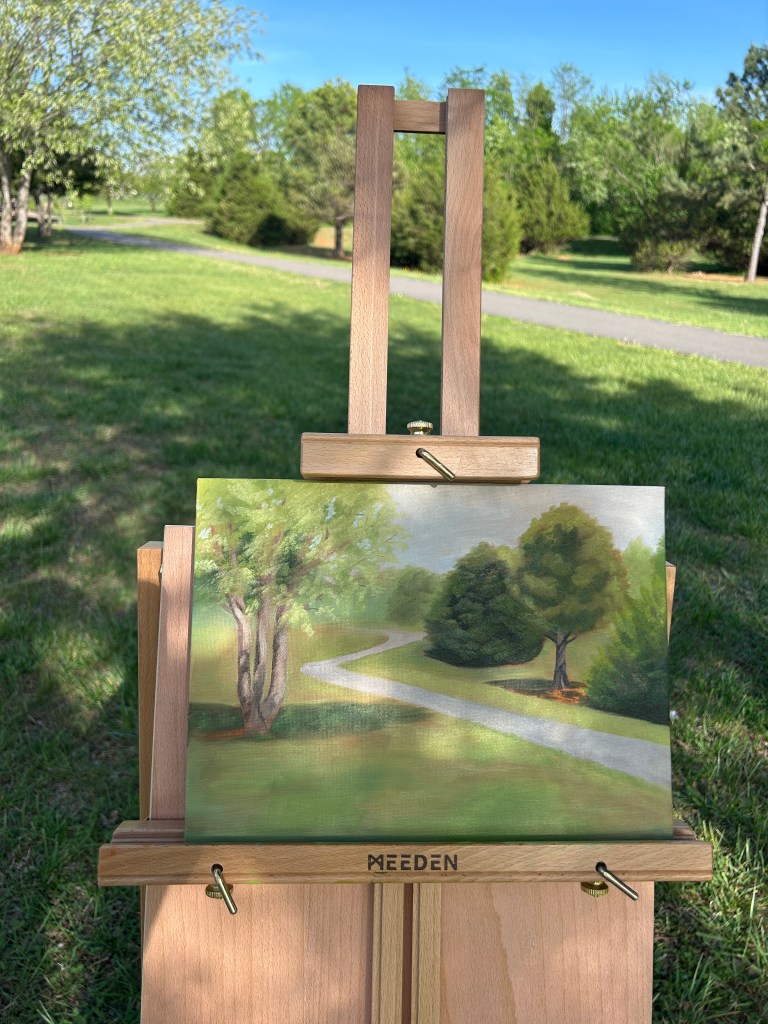
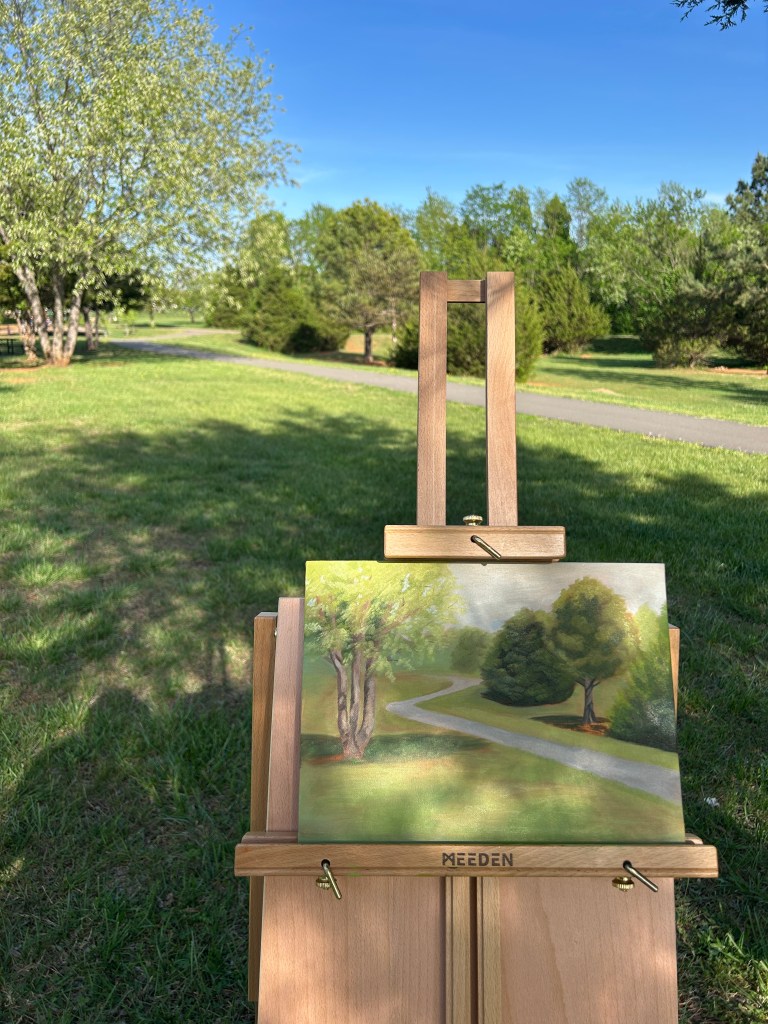
Here’s the final result, a 3.5-hour study of the Forest Library Park.
Reflection
I was recently reading a graphic novel about the lives of Tolkien and Lewis, Mythmakers, and the author mentioned Tolkien’s infamous short story, “Leaf by Niggle.”
In the story, Niggle, a nitpicky painter, is obsessed with painting a magnificent tree, leaf by leaf and branch by branch. He is particularly invested in the leaves, however, rather than the overall tree, and is more skilled at painting them. But annoying neighbors and other obligations keep pulling him away from his work, and at last he is called upon to take a long journey, by train, to a far-away place from which he will never return.
All his work was for nothing (or so it seemed…)
It’s a beautiful story. Tolkien said he simply woke up one day with it all in his head. But it’s more than just a fable—it describes Tolkien’s ongoing struggle with finishing The Lord of the Rings. An incorrigible perfectionist, he was so wrapped up in the minute details of worldbuilding, of crafting intricate maps, timelines, and histories, that he felt hopelessly far from ever completing (by far) the most celebrated of his life’s works.
He was missing the trees for the leaves.
I think in the end, we are all grateful for his relentless attention to detail, for his refusal to settle for mediocrity or a vague understanding of the monumental world his imagination had birthed. The end result (after seventeen years!) was one of the most remarkable, magnificent, well-loved trilogies in history, and the predecessor of all modern fantasy.
Sometimes I resonate with Tolkien. I feel overwhelmed by complexity, lost in the details.
I’d rather just paint a leaf, to be honest.
But the trees are there. They are beautiful, and their beauty is begging to be painted.
If I never challenge myself to take on a tree, what will I say in the end, when all I have to show for myself is many, many paintings of—leaves?
I was forced to paint the trees this week. I was forced to paint different kinds of trees. And you know what?
It wasn’t all bad.
I still have a long, long way to go in my oil painting journey. Truly great oil painters possess this incredible skill to simplify what they are seeing in such a way that it almost looks more real on the canvas than it does to the naked eye. Every brushstroke, every deliberate choice of light, temperature, value, composition, and texture contributes to a beautifully unified depiction of the subject. Such mastery feels so far out of my reach!
But this week, something happened: I actually felt that I was applying some of the techniques I’ve studied. Rather than simply painting the way I am accustomed to, painting my way, I tried to put the tried-and-true techniques into practice.
Here are a few things I did differently:
- I used different kinds of brushes, including a natural, rather than just synthetic. The natural brush added some nice textural variety and softness in the trees.
- I let the underpainting show through, which added warmth and cohesiveness.
- I attempted to add “sky holes” in my main tree after blocking in the foliage.
- I blocked in main shadows first and left them in place, even though the light changed.
- I blocked in the darks of the trees first, then built up the lighter values.
These simple changes made a difference. Though there is still much that could be improved, I could tell that my approach had fundamentally shifted for the better.
So let this be a reminder to you as well:
Don’t miss the trees for the leaves.




Leave a Reply